
How Digital Personas Were Developed

Digital Personas were developed through a two-round, mixed-methods study conducted over two years across Kenya, Nigeria, and Senegal. The approach combines in-depth qualitative research with population-level data, allowing personas to be grounded in lived experience while situated within broader population distributions.
Construction of Qualitative Personas
The qualitative component of this work was conducted across Northern Nigeria, Southern Nigeria (Urban), Kenya, and Senegal, in partnership with Yux Design. In both rounds, recruitment was anchored to Pathways Segments, an existing population-representative segmentation based on health outcomes.
This allowed the research to be rooted in an outcome-oriented framework. While Pathways focuses on health vulnerabilities, many of the underlying drivers, such as access, agency, and social norms, also shape livelihood outcomes. Digital Personas builds on this foundation, examining how digital access and use connect to broader outcomes in women’s lives.
Across two rounds, we conducted over 250 interviews with women, alongside interviews with spouses, children, peers, and others who influence their digital journeys.
Round 1
Explored women’s digital lives more openly, focusing on access, use, mediation, agency, and the broader social and normative context shaping engagement.
Round 2
Focused more specifically on how women use digital tools in practice, particularly in domains such as health, livelihoods (including agriculture), and education.
| Sample | Kenya | N. Nigeria | S. Nigeria | Senegal | Total | |
|---|---|---|---|---|---|---|
| Round 1 - Women | Urban | 26 | 15 | 20 | 33 | 198 |
| Rural | 35 | 25 | -- | 44 | ||
| Round 1 - Facilitators | 38 | 30 | 9 | 20 | 97 | |
| Round 2 - Women | Urban | 10 | 6 | 10 | 12 | 75 |
| Rural | 4 | 8 | -- | 15 |
Both rounds of research across all 3 countries received IRB approval at the country level.
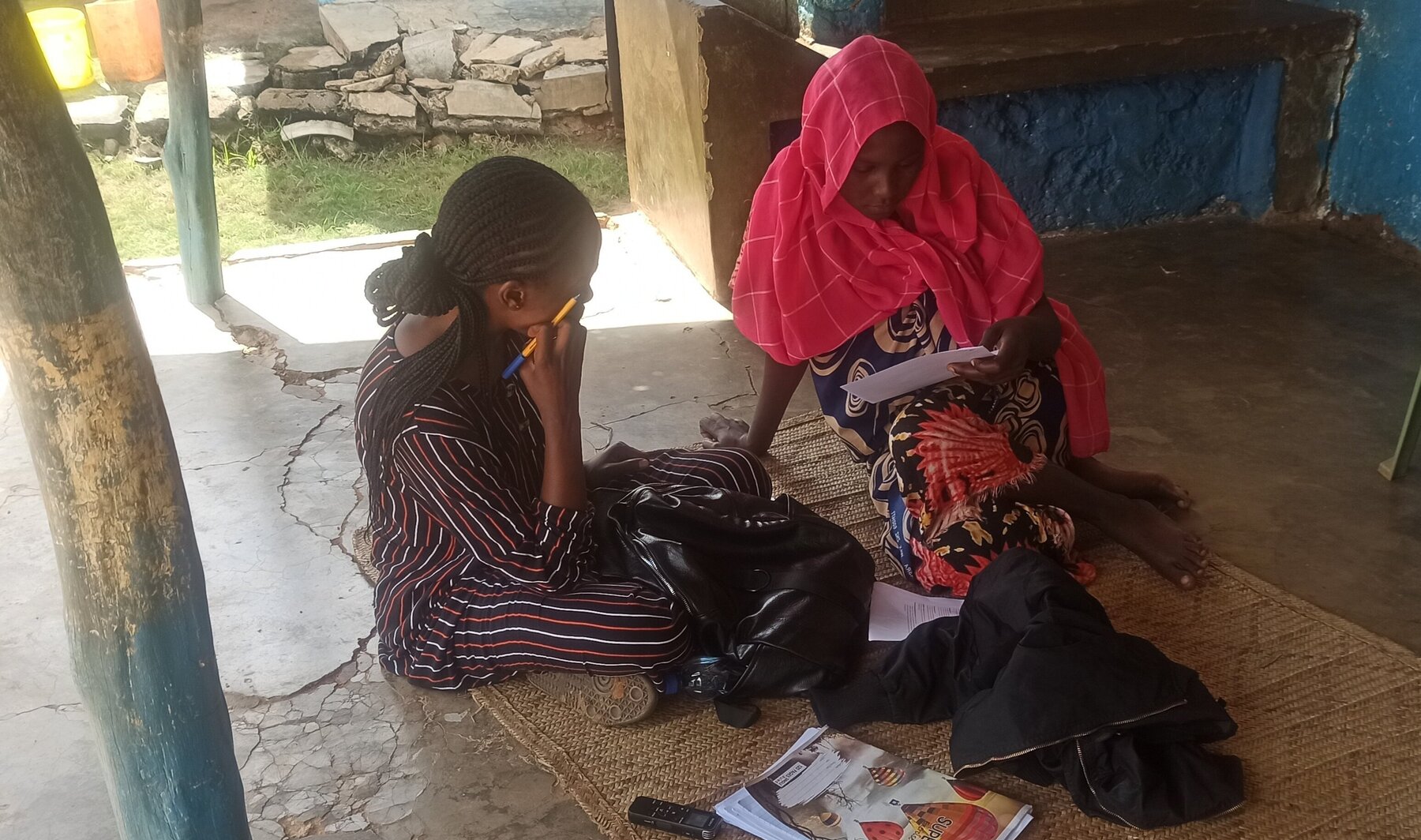
Alongside this work, Decodis conducted a parallel study in the same geographies on related themes. During analysis, we engaged with Decodis at multiple points, incorporating relevant insights from their data into our broader synthesis.
Analysis was conducted inductively using the KJ method (Iba et al., 2017), an approach designed to surface patterns from complex qualitative data without imposing predefined categories. Through iterative clustering and synthesis, key patterns emerged, describing how digital access and use are shaped in practice.
These patterns were organised into five interconnected dimensions that structure each persona:
| Relevance: How and why digital tools matter in everyday life |
| Skills: Capabilities and learning pathways that shape use |
| Safety: Awareness of risks and strategies for navigating them |
| Affordability: Financial constraints shaping access and continuity |
| Norms: Social expectations and permissions governing digital use |
These dimensions capture how digital engagement is experienced, negotiated, and sometimes constrained within everyday life.

Quantitative Mapping of Personas
To situate these qualitative constructs within population-level distributions, we mapped personas to Demographic and Health Survey (DHS) data.
We began by identifying key digital outcome variables in the DHS, including phone ownership, smartphone ownership, internet use, and mobile-based financial transactions. We then conducted association analysis to identify variables that were strongly linked to these outcomes.
The diagram below is a cropped version of an association heatmap that visualises the relationships between digital outcome variables and with other variables in the DHS in Northern Nigeria.

These strongly linked variables were mapped back to the dimensions that define each persona. For example, dimensions such as affordability or norms could be linked to corresponding variables such as wealth, decision-making, or social attitudes.
On this basis, we developed a rule-based typing approach that assigns each respondent in the DHS dataset to a persona. Unlike predictive clustering approaches, this method remains transparent and interpretable, allowing clear links between observed variables and persona definitions. This makes it possible to:
| Estimate the distribution of personas within populations and specific geographies |
| Map personas to Pathways Segments |
| Analyse how broader social and economic factors vary across personas |
This approach positions Digital Personas as hybrid constructs: rooted in qualitative insight, while systematically extended into population-level analysis. Read more about our mapping process here.
Extended analytical outputs
Because personas are systematically linked to DHS data, they can also be analysed across time and geography in ways that extend beyond qualitative interpretation alone.
Tracking change over time
By applying the typing approach across multiple DHS waves, it becomes possible to examine how the distribution of personas changes over time. The example below compares persona distributions across Nigeria between DHS 2018 and DHS 2024, illustrating shifts in digital capability and engagement across rural and urban contexts.

Geospatial mapping of personas
The mapping approach also enables personas to be visualised geographically at cluster, district, and state levels. The example below shows how dominant personas vary geographically across Nigeria, using DHS-linked persona assignments at the survey cluster level.

These forms of analysis make it possible to examine how digital engagement varies spatially and temporally, supporting more targeted and context-sensitive approaches to digital design and intervention planning.
Notes
DHS versions and dates
The quantitative analysis presented on this website uses the following DHS datasets:
- In Kenya we have used DHS-8, 2022
- In Nigeria we have used DHS-8, 2024
- In Senegal we have used DHS-8, 2023
Quantitative sample
All quantitative analysis is based on the DHS sub-sample aligned with the Pathways segmentation criteria in each country. These criteria define the population of “segmentable” women of reproductive age used for analysis.
- Kenya: women aged 15 – 49 with a child aged 5 or under
- Nigeria: women aged 15 – 49 with a child aged 10 or under
- Senegal: women aged 15 – 49 who have given birth
Ability to read
For each persona, reading ability is presented using two indicators: Can read full sentences and Cannot read at all. These refer to the respondent’s ability to read in a language of her choosing from those included in the DHS survey.
Household decision-making
Women’s participation in household decision-making is presented in the affordability section of each persona. This is a custom index based on whether women report participating, either alone or jointly, in four or more of the following decisions:
- respondent’s own health care
- large household purchases
- visits to family or relatives
- use of husband’s earnings
- use of respondent’s own earnings
- use of contraception
Internalisation of domestic violence
Women’s internalisation of domestic violence is presented in the norms section of each persona. This is a custom index based on whether respondents agree that wife-beating is justified in at least one of the following situations:
- if she goes out without telling her husband
- if she neglects the children
- if she argues with her husband
- if she refuses to have sex with her husband
- if she burns the food
Experience of domestic violence
For personas in urban and rural Kenya, experience of domestic violence is presented in the norms section. This is a custom index based on whether respondents report any of the following:
- emotional violence
- less severe physical violence by a husband or partner
- severe physical violence by a husband or partner
- sexual violence by a husband or partner
Barriers to medical care access
In some stories, barriers to accessing medical care are presented as a data point. This is based on whether respondents report any of the following barriers:
- getting permission to seek care
- getting money for treatment
- distance to a health facility
- not wanting to go alone
Control issues
In some stories, control issues faced by women are presented as a data point and categorised as no control, moderate control, or high control. This is based on a DHS index that counts the number of controlling behaviours reported by respondents, including whether a husband or partner:
- is jealous if she talks with other men
- accuses her of unfaithfulness
- does not permit her to meet female friends
- tries to limit her contact with family
- insists on knowing where she is
- uses mobile technology to check her whereabouts
Data from Decodis
In some cases, findings from an IVR survey conducted by Decodis are included in the personas and stories. Where this data is used, the sample size is provided. Detailed documentation of Decodis’ methodology will be linked here when available.