

- Age
- 35 Years
- Location
- Tambacounda
- Marital Status
- Married
- Education
- No Education
- Pathways Segment
A rural Senegal woman managing household and farm work with limited digital use.

Women engage with only the parts of digital technology that feel safe, understandable, and supported. When those conditions are narrow, digital relevance shrinks and with it, motivation to learn or adopt more. Design efforts must start from what already feels useful and permissible, even if the scope is limited.
How She Uses the Phone
Fatoumata is 35 and lives in a village in South Senegal with her husband and four children. She contributes to the household by working alongside her husband in their rice field and managing most domestic responsibilities. She did not receive much formal education and cannot read or write in French. Her eldest daughter is 17, and the younger children are still in school.

Fatoumata’s first smartphone came as a hand-me-down from her brother. She had asked for a phone mainly so she could stay in touch with family members. Although it was a smartphone, she did not use it as one. For her, it functioned mostly like a basic phone, used for making and receiving calls. Data was expensive, and she was careful not to waste airtime. Her children installed apps like WhatsApp and Facebook on the phone, but she rarely opened them. “I didn’t really know what to do inside,” she says. “I just wanted the phone to work when I needed to call.”
Occasionally, one of her sons would load videos onto the phone, and in the evenings she would sit with her children and they would watch them together. But she never learned how to search, download, or manage apps herself.

When the phone fell into water one day while she was washing clothes, she tried to save it by putting it in rice, but it never turned back on. Repairing it was too expensive, and the household could not afford a replacement.
For almost a year, Fatoumata had no phone at all.
Eventually, a friend sold her a second-hand basic phone at a low price. Her children missed the smartphone, but Fatoumata did not. “I never really knew how to use it,” she says. “This one is enough for me.” With the basic phone, she makes and receives calls, listens to the radio, and uses the flashlight at night when the power is out. The radio has become especially important to her. She listens regularly to religious programmes and sermons while cooking or resting. This feels safe and familiar and fits easily into her daily routine.

Fatoumata is also cautious about smartphones. Some time ago, a woman in her village was exposed after private videos were shared online by a man she had been involved with. The consequences were severe – she was ostracised, and her life in the community was deeply affected. The story is well known in the village and has shaped how many women think about phones. “Of course I have nothing to hide,” Fatoumata says, “but sometimes phones can be dangerous for a woman.” Since then, she has felt that simpler phones are safer and easier to control.
Her Ecosystem of Learning and Facilitation
Fatoumata learned how to use her phone mainly through her children. They showed her how to answer calls and how to end them. She learned by watching and then doing the same steps again and again. She never learned how to save numbers herself. Her eldest daughter saves contacts for her and uses names or simple symbols so Fatoumata can recognise who is calling.
Her husband is much older and does not know how to use phones beyond answering calls himself. He cannot teach her, and she does not expect him to.
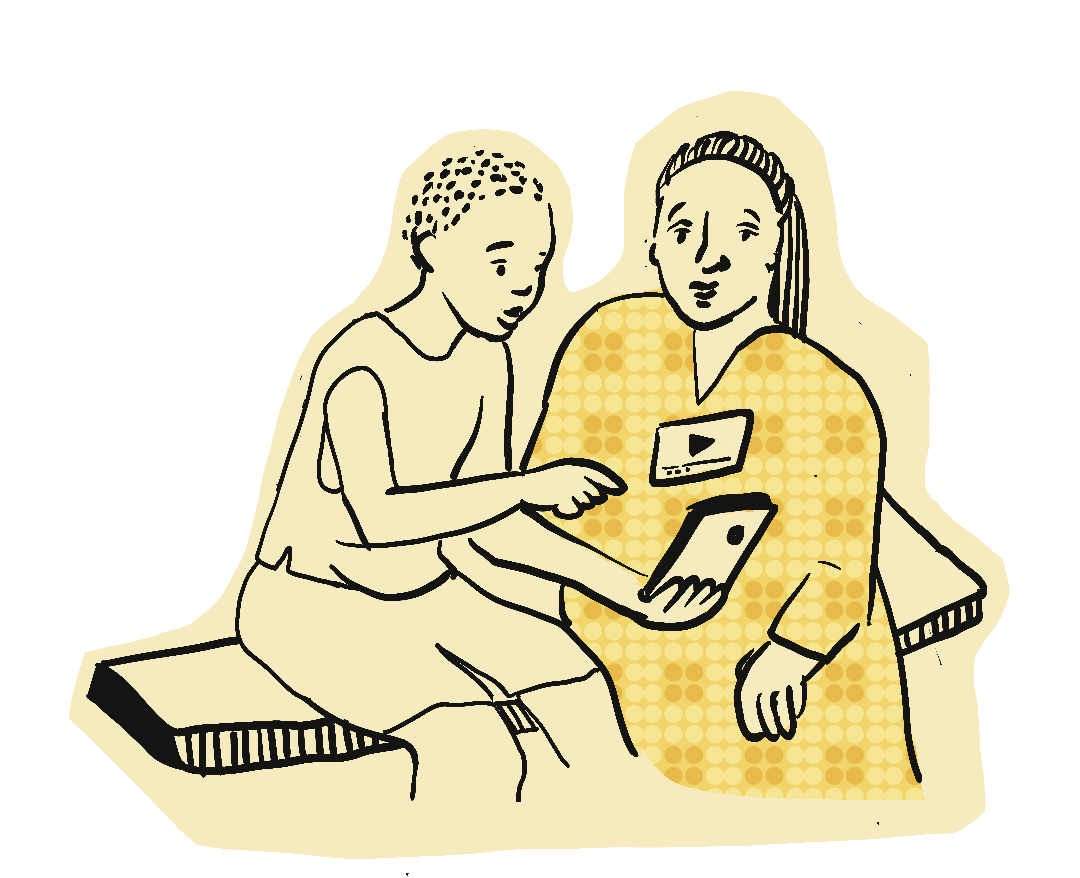
When something goes wrong with the phone, she usually waits for one of her children to help. “They understand it better than me,” she says.
Fatoumata has never felt the need or had the confidence to learn more than these basic functions. She does not browse, message, or explore other features. For her, the phone is a tool for communication and listening, not something to experiment with. “This is what I know,” she says. “And it is enough.”