

- Age
- 23 Years
- Location
- Lagos
- Marital Status
- Married
- Education
- Incomplete Secondary
- Pathways Segment
A home-based tailor using a basic phone to stay reachable and support her work

When women gain access to phones and begin using them in small, practical ways, often with initial support from others, visible benefits start to emerge. Seeing this value, whether in work, learning, or daily coordination, reinforces the desire to sustain access and use, and can gradually shift attitudes toward keeping that access stable or even improving it.
How she Uses the Phone
Aisha is 23 and recently moved to Lagos from a rural area in southern Nigeria after getting married. Before the move, she did not own a phone. She relied on her husband’s smartphone whenever she needed to make a call or speak to family. “If he was not around, I just waited,” she says. Her access was entirely dependent on him. After moving to Lagos, her husband bought her a basic feature phone so she could at least make and receive calls on her own. This was important in the city, where being reachable matters.
Aisha now runs a small but steady tailoring business from home, stitching clothes for women in her neighbourhood.

Most of her customers call her directly to place orders or check on progress.
The phone has made her work more consistent. “Now they can call me anytime,” she says. But it also reveals its limits. Many customers want to share photos of styles on WhatsApp, and Aisha cannot receive them on her phone. Instead, they send the images to her husband’s smartphone. She then waits for him to show them to her. “It is not easy,” she explains. “Sometimes he is not around, or he is busy.” Because of this, Aisha has started asking for her own smartphone. She feels it would make things easier for her work, even if she is not fully sure how she would use all its features. “If I have it, I can respond quickly,” she says. “It will help me make more money.” Her husband is not opposed, but the decision is still his to make, and for now she continues to manage with what she has.

Reading English remains difficult for Aisha. She can recognise some words, but she often struggles to fully understand written messages. When customers send texts, she sometimes asks her husband to read them aloud or explain what they mean. This makes her cautious about relying too much on messaging and reinforces her preference for calls.
Aisha has heard that people use YouTube to learn tailoring techniques. When she needs to try something new or is unsure how to stitch a style, she asks her husband to search for videos for her to watch. She does not explore this on her own, but uses it when the need comes up.
Her Ecosystem of Learning and Facilitation
Aisha’s learning is closely tied to her husband. He is her main facilitator and the person she turns to whenever she needs to use features beyond calling. Before and after marriage, it was through him that she first encountered smartphones, watching him send messages, search online, and use apps.
When she needs to learn something, like finding a tailoring style, she sits with him as he demonstrates. He shows her how to open YouTube, type in searches, and select videos. Aisha watches carefully and tries to follow along. “When I see him do it, I try,” she says. “If I don’t try, I will forget.”
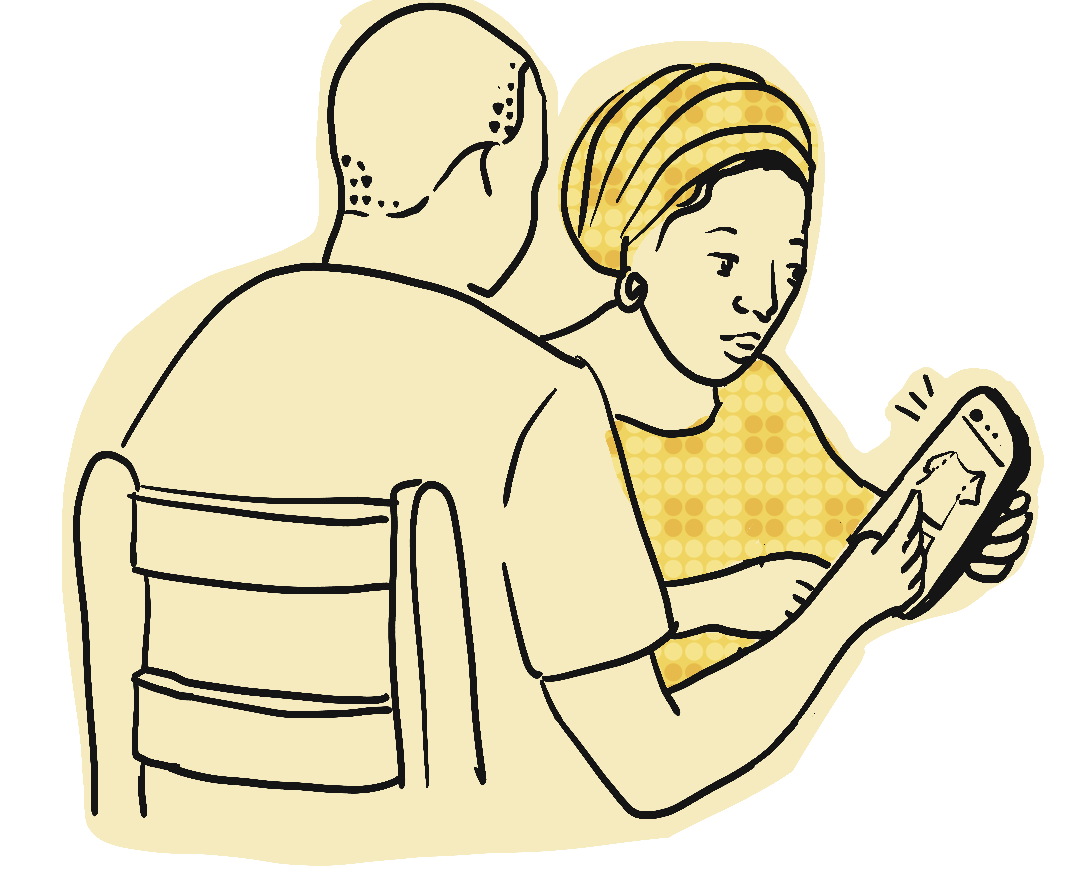
These learning moments are irregular, short, guided sessions followed by long gaps where she cannot practise on her own. They depend on his availability and willingness to sit with her.
As a result, she has learned some functions, like recognising icons and navigating basic screens, but has not yet developed full confidence. For Aisha, learning happens when there is a need, but it is still shaped by limits in access, support, and opportunity.
