
Northern Nigeria Urban
Summary
Introduction
Relies entirely on others to access and use digital tools, with little or no independent capability.
Engages with digital tools with real-time support, building basic capability through guided use.
Uses digital tools independently for a defined set of tasks, within a limited and stable repertoire.
Navigates digital tools independently across contexts, including more complex and evolving systems.
Pathways Segment
Of Reproductive Age Women
Devices
Relevance
Mobile Ownership (DHS-8 2024)
Smartphone Ownership
Uses Mobile for Financial Transactions
Any Internet Use Last Month
Functional Use
Basic communication, mostly through calls, with supplementary radio use for information and entertainment, with some reliance on others to enable or support use.
Entirely offline use across media, USSD transactions, and data-less apps, supporting entertainment, minor skilling, and basic transactions.
Mixed use combining basic WhatsApp, offline media, and USSD/data-less apps, supporting entertainment, minor skilling, and limited transactions.
Data-led use across apps and services for connection, network building, and business, with some use for information seeking and transactions.
Functional Use Deep Dive
Reach and Connection
Use is focused on personal communication and limited to making and receiving calls. Some women who have sales based livelihoods may also use phones to communicate with their customers or suppliers. Messaging is not operated directly, text messages are sent and read with help from others.
Use is focused on personal communication and limited to making and receiving calls. Some women who have sales based livelihoods may also use phones to communicate with their customers or suppliers. Messaging is not operated directly, text messages are sent and read with help from others.
Use is primarily for personal communication. Uses WhatsApp to send and receive voice notes with known contacts, with limited use beyond this.
Uses WhatsApp primarily for group learning and coordination for business. Communicates on WhatsApp using voice notes, images, and groups. Uses Facebook to expand her social network.
Entertainment and Stress Relief
Listens to the radio for entertainment and religious sermons.
Entertainment is primarily offline, centred on media shared via Xender/Bluetooth, including audio and video, and reading material for those able to read (likely in Arabic). Usage could include offline apps such as cooking apps, games, or basic photo filters, with engagement oriented toward consumption rather than posting or active social participation.
Entertainment is primarily offline, centred on media shared via Xender/Bluetooth, including audio and video, and reading material for those able to read (likely in Arabic). Usage could include offline apps such as cooking apps, games, or basic photo filters, with engagement oriented toward consumption rather than posting or active social participation.
Active participation on social media is present but could be shaped by normative constraints. May seek news online and use data-dependent apps such as online religious content.
Learning and Growth
May listen to health-related information and religious learnings on the radio. Learning is passive, based on listening to broadcast content rather than seeking specific information.
Uses offline apps to learn practical skills such as cooking and stitching, and listens to health-related information on the radio. Learning can be active - intentionally accessed through apps, or passive, via radio-based content.
Primarily learns passively and with offline means such as data-less apps or radio. At times may join closed WhatsApp group on topics such as childcare or nutrition when invited by known contacts.
Learning is often shaped by both livelihood and personal needs. Active information-seeking occurs via Google for educational content and news, Facebook for business-relevant information, and YouTube for specific videos. May use basic, purpose-specific apps such as Hausa/English dictionary and cooking apps to upskill. Exploration is largely restricted to activities aligned with expected gender roles, while still creating space for livelihood-related learning.
Transactions and Financial Security
No independent use of digital financial services.
No independent use of digital financial services.
May occasionally use USSD for transactions, but lacks access to app-based financial services.
Uses OPAY for transactions. May use banking-related apps for savings.
Self Promotion and Expression
Limited or no engagement in self-promotion or expression.
Limited or no engagement in self-promotion or expression.
Limited or no engagement in self-promotion or expression.
Uses WhatsApp and Facebook to promote business and seek business-related information including via closed online groups. Overall, expression on social media is limited and shaped by norms, leaning toward controlled, purposeful engagement (status updates, posting, and group participation).
Health and Finance Tracking
Does not engage in health or financial tracking.
Does not engage in health or financial tracking.
Does not engage in health or financial tracking.
May use specific apps for tracking health (e.g., reproductive health), and finance (OPAY).
Skills
Has Secondary and Above Education
Can Read Full Sentences
Cannot Read at All
Skills
Has no prior exposure and minimal literacy; use is highly constrained, with basic functions supported by others and limited scope for independent learning.
Has little prior exposure and partial literacy, limiting use to basic functions; learning requires step-by-step support, with ongoing reliance on family for most tasks.
Has limited early exposure but functional literacy, which enables basic use; learns through experimentation and occasional support, with family members assisting in more complex tasks.
Has early exposure and English literacy, enabling independent use and exploration; learns proactively and can transfer skills across apps, seeking one-off support for new tasks.
Skills Deep Dive
Base Capabilities
No early digital exposure coupled with little to no literacy implies likelihood of very limited learning.
Little to no early digital exposure implies that most learning happens in adulthood, supported by partial literacy.
Likely had limited early exposure to digital. However, may have functional English and Arabic literacy, which may still support some self-directed learning.
Has likely had some early exposure to phones. This coupled with English literacy supports her ability to navigate devices and apps. Likely learnt basics at an early age or by observing others around her.
Learning Style
May need support to make and receive calls. Learning, if it happens, is largely through pattern memorisation.
Likely requires step-by-step demonstration and sustained support for anything beyond the basics. May not be able to transfer skills across devices.
Curious and likely to experiment; seeks help for complex tasks but does not require ongoing support for general, offline use.
Keen to learn and tries things independently before seeking help. Can expand use and transfer learnings across apps.
Learning Needs
Likely needs to be taught how to make and receive calls and use the radio, but may not require ongoing support.
Needs support for tasks beyond the basics, including saving numbers and accessing offline media.
Likely needs ongoing support for tasks like blocking numbers and making video calls. Simpler tasks such as sending voice notes and consuming offline media may only need one-off demonstration.
Likely able to master most communication-related tasks autonomously and continue independently after initial setup and demonstration. May need one-off support to initiate new use cases.
Facilitators
Facilitation is likely to come from immediate family members, as she requires ongoing support.
Facilitation is likely to come from immediate family members, as she requires ongoing support.
Family members are likely to be primary facilitators. May depend on husbands and other men in the family for relatively advanced tasks, based on the belief that they are more digitally savvy.
Apart from spouses and children, facilitators may include female friends outside the immediate family who support early digital use. They are digitally capable and open to supporting more expansive use.
Findings Across Personas
Pattern memorisation can support feature phone use, but smartphones require understanding interfaces rather than repeating fixed sequences.
In normatively restrictive settings, younger facilitators may open up more opportunities, as they may be more willing to support expansive use.
Safety
Safety
Use remains limited, with minimal awareness of risks and no proactive response.
Limited use reduces both risk awareness and the need for active response.
Has some awareness and mitigation practices, but may rely on self-restriction and share responsibility with husband who monitors use.
Aware of risks associated with greater use and may take precautions, though responses may be shaped by prevailing social norms and expectations around use.
Safety and Security Deep Dive
Perception of Risk
May face threats via calls, such as fraud, but exposure remains low due to limited use.
May face threats via calls, such as fraud, but exposure remains low due to limited use.
May encounter risks on WhatsApp. Awareness of fraud and obscenity can raise fears.
More exposed to digital risks due to broader use, including social media. Aware that increased visibility can invite risk.
Perception of Risk by Others
Very limited use means scrutiny is minimal and risk is not actively monitored.
Limited, socially acceptable use means scrutiny is low and monitoring is often seen as unnecessary.
Husbands may monitor use to manage perceived risk. She may accept this monitoring as shared responsibility for safety, reflecting internalised gender norms. May pass on caution to children.
Scrutiny from husbands or others may increase as perceived risk rises, particularly with broader or more visible use.
Response to Digital Risks
No proactive response required due to limited use.
No proactive required response due to limited use.
May stop using apps altogether after encountering threats. May self-restrict certain forms of social media use to avoid male attention. May also self-restrict after encountering obscenity or fearing norm violations. Often extends caution to children. Uses locks and passwords to manage risk.
Takes precautionary steps such as blocking users. Responsibility for safety is often assigned to platforms or institutions. Less likely to self-restrict for learning or business use unless there is a serious risk of overstepping acceptable gender norms. May also restrict children’s use and help them navigate digital risks.
Learnings from Interactive Voice Response Survey
Among the 404 women in urban Northern Nigeria who responded to questions on phone security, approximately 67% reported that the phones they used had PINs or passwords as a security measure.
Affordability
Is in the Top 40% by Household Wealth Nationally
Has Year Long Employment or Livelihood Activity
Participates in Household Decision Making
Partner Works in a Professional or Managerial Role
Household has Electricity
Device Resourcing
Dependent on hand-me-down or borrowed phones for basic needs, with access often mediated or enabled by others.
Relies on hand-me-down or borrowed phones for basic needs like calling; may sometimes own a basic phone provided by her husband post-marriage.
May typically receive phones from suitors or husbands, often around or after marriage.
They may buy their own phones but may also receives phones through male family members (fathers, elder brothers, later husbands), sometimes early as rewards tied to educational milestones.
Discontinuities
Disruptions are minimal, as basic functions can be maintained through shared or borrowed devices; may restrict certain features (e.g., flashlight) to conserve airtime and battery.
Disruptions are not significant due to limited reliance on phones, with impacts mostly on entertainment and media use.
Disruptions related to data shortages primarily affect WhatsApp use and may persist over extended periods, while offline use remains less affected.
Disruptions are keenly felt due to broader, more data-dependent use; may borrow to maintain basic use, but breadth and quality drop sharply.
Resourcing and Purchasing Deep Dive
Early Access to Device
Unlikely to have had early phone access. Husbands may provide basic phones for contact, but ownership may be inconsistent.
Unlikely to have had early phone access. Husbands may provide basic phones to enable contact.
May have had limited early phone access, often through parents or siblings. May receive phones from suitors or husbands even before marriage.
Likely to have had some early phone access, by borrowing from parents or siblings. Parents may gift phones for key educational milestones. Access to devices may improve after marriage.
Current Device Access
May have a basic phone for calling. But could also be reliant on borrowed phones during access disruptions.
Likely has a basic or feature phone, or share a device with her husband, children, or co-wife when she does not have her own.
May own a basic smartphone. May borrow phones from family and close friends to meet specific needs, such as a better camera or larger screen for watching films.
Has a smartphone. Likely does not need to borrow.
Access to Data, Airtime and Charging
Almost entirely dependent on others for airtime purchase.
Requires others to provide airtime and load media.
May have partial capacity to purchase data and airtime. Likely independently acquires media and distributes it to others, mostly within normatively sanctioned spaces such as neighbourhoods or social gatherings.
Likely buys data independently and has greater access to media centres. May also act as a media distributor for others.
Discontinuities Deep Dive
Disruptions Caused by Financial Shocks, Damage, Degradation and Loss
Disruptions have minimal impact, as phones can be borrowed for urgent use.
Disruptions occur fairly often but primarily affect entertainment and media consumption. Borrowing phones mitigates the worst effects.
Disruptions may occur fairly often and lead to reduced quality of use. Borrowing phones may mitigate the worst effects but lowers overall engagement.
As she derives significant value from digital use, disruptions cause a sharp decline in both breadth and quality of use. Borrowing phones may mitigate the worst effects but reduces overall engagement. Downgrading to a feature phone can be difficult and frustrating.
Managing Recurring Costs (data, airtime etc.)
Disruption is not keenly felt as use is basic and can be supported with borrowed devices.
Recurring costs are largely for airtime, not data. While running out of airtime creates some disruption, it does not significantly affect offline media consumption.
Managing recurring costs such as data and airtime is a frequent source of disruption. Data gaps are felt when WhatsApp access is disrupted, and reliance on her husband to purchase data can prolong interruptions.
Managing recurring costs such as data and airtime is a key source of disruption due to data-dependent use. She may have some autonomy in purchasing data and mitigating disruptions.
Charging Cycles
Likely depends on charging centres, but their proximity to these centres and limited phone use may mean batteries last longer, reducing disruption.
Power sources are often available nearby or at home. When this is not the case, careful battery management is required.
Power sources are often available nearby or at home. When this is not the case, careful battery management is required.
Charging is unlikely to be a major source of disruption due to reliable access to power, including at home. She can also access nearby charging centers independently, further reducing the likelihood and duration of interruptions.
Findings Across Personas
Women in urban NN are likely to face significant discontinuities in their digital journeys, which can occur frequently and last for long periods. Women’s phone use is often deprioritised relative to men’s and gains legitimacy mainly when it supports income or business, reinforcing gendered digital disparities.
Some women experience extended periods without reliable phone access due to loss, damage, or inability to afford repairs or replacements. During these periods, reliance on borrowed devices degrades usage, learning, and overall experience. These disruptions can also occur if they lose access to facilitators critical to their learning.
Learnings from Interactive Voice Response Survey
Among the 42 women in urban Northern Nigeria who responded to questions on mobile data use and spending, the median frequency was once per week, at a median cost of $0.19 for 1.25 GB of data. In some cases, data may be purchased for women by others rather than by the women themselves.
Among the 404 women in urban Northern Nigeria who responded to questions on phone charging, approximately 30% reported charging their phones at stations outside their homes.
Among the 25 women in urban Northern Nigeria who reported using charging stations outside the home, phones were kept there for an average of 21 hours per week.
Norms
Has Internalised Domestic Violence
Impact of Control and Coercion on Digital Access and Use
Faces little normative scrutiny due to basic use; norms are largely internalised.
Restrictions are more likely to be internalised and self-imposed; use is less visible and less likely to attract scrutiny.
Faces normative scrutiny from husbands, especially around online use, which may constrain expansion of use.
Has some independence, particularly when digital use contributes to household income, and can negotiate access, but may face friction around usage that spouses are not comfortable with.
Norms Deep Dive
Norms, Control and Coercion
With little to no early exposure, restrictive norms after marriage may be more readily accepted and internalised. Scrutiny remains limited because her usage is minimal.
Older women in these groups, especially those with limited early digital exposure, may not recognise the value of digital use and may internalise and reinforce restrictive gender norms. This tendency is often more pronounced among more vulnerable women with limited education.
With little to no early exposure, restrictive norms after marriage may be more readily accepted and internalised. Scrutiny remains limited because her usage is minimal.
Older women in these groups, especially those with limited early digital exposure, may not recognise the value of digital use and may internalise and reinforce restrictive gender norms. This tendency is often more pronounced among more vulnerable women with limited education.
Likely grew up in a less normatively restrictive environment but lacked exposure and resources. After marriage, norms shaped by her husband may be more restrictive, with scrutiny limiting use largely to WhatsApp (where interactions with strangers are less likely) and constraining further exploration.
When husbands are better educated, they may be more open to supporting extended digital use by their wives.
Likely grew up in a less normatively restrictive environment. This may continue after marriage as husbands may not actively control, particularly if she contributes to household income. In some cases, restrictive gender norms or insecurity around infidelity may cause friction with the husband, leading her to likely moderate her use within sanctioned boundaries.
Husbands are often more educated and less restrictive, and may encourage wives’ learning as a marker of modernity and social standing. Women may also negotiate greater access due to higher exposure and competence before marriage.
Distribution
U1 NN
U2 NN
U3.1 NN
U3.2 NN
Stories
Stories

Khadija
An older woman in urban Kano who rejects phone use to uphold household norms and values

Amina
A food seller using a basic phone to support her daily business and routine
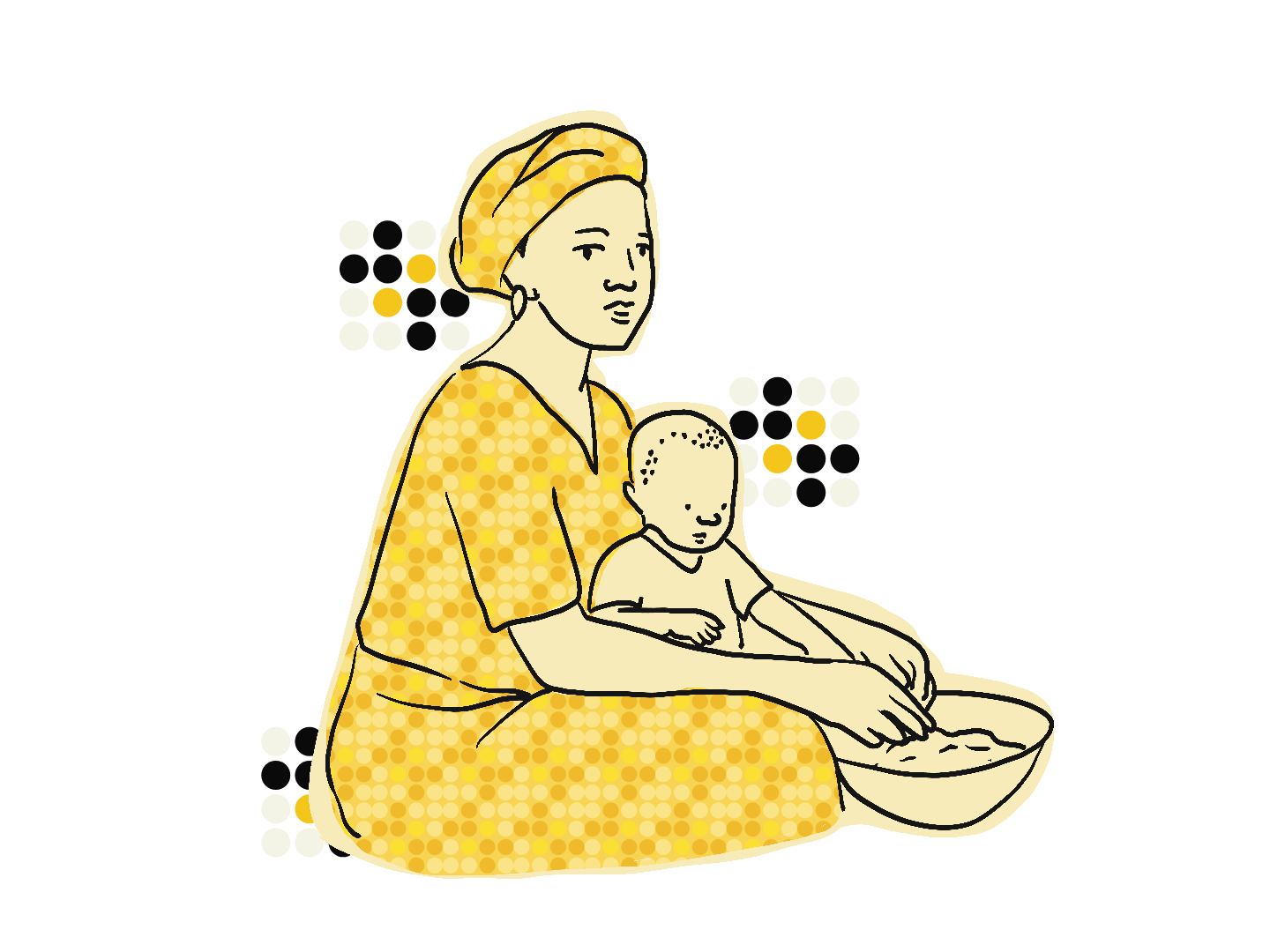
Hafsa
A young mother engaging with digital spaces primarily through listening and observation

Agatha
A peri-urban Kano poultry farmer using her phone to support her business and local networks.